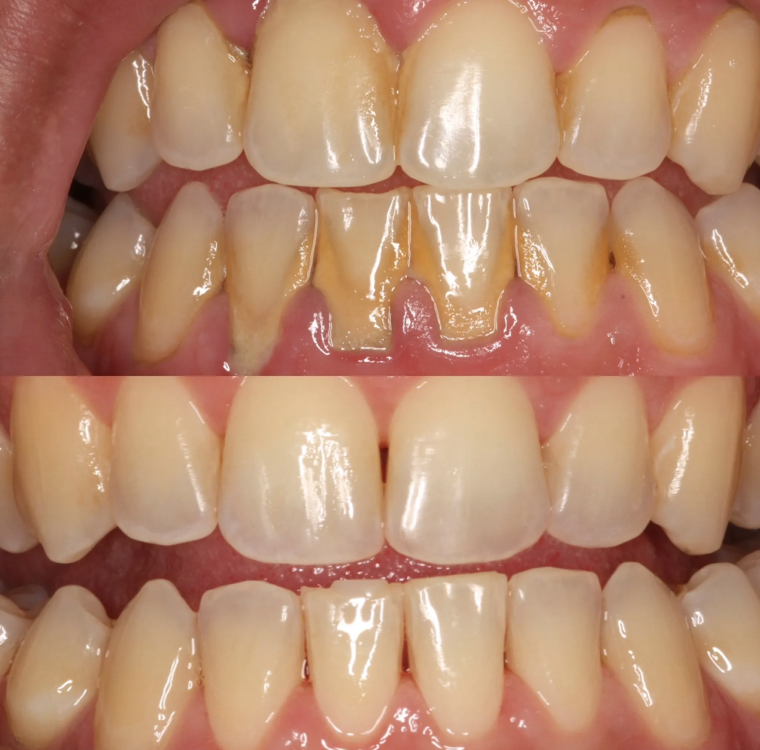
We often think of brushing and flossing as enough to keep our teeth clean. They are essential, but some deposits can remain stuck around and between the teeth—especially near the gumline. Over time, these deposits can affect not just your gums, but also the bone that supports your teeth.
What holds your teeth in place?
Your teeth are not simply sitting inside your gums. Each tooth is held firmly within the jawbone and supported by the surrounding gum and other supporting tissues. The area where the tooth meets the gum is particularly important. When plaque and hardened deposits such as calculus build up along this junction, they can continuously irritate the gums.
What happens when deposits are left behind?
The gums can become inflamed, swollen and prone to bleeding. If this inflammation continues for a long time, it can affect the tissues and bone supporting the teeth. As the supporting tissues and bone are gradually lost, the tooth has less support. Over time, this can lead to gum recession, spaces around the teeth and eventually tooth mobility or loosening. So scaling isn't simply about making your teeth look cleaner. It is about protecting the tissues that help keep your teeth firmly in place.
How does professional scaling help?
Dental scaling is a professional cleaning procedure used to remove deposits that cannot be effectively removed through regular brushing alone.At the clinic, an ultrasonic scaler is commonly used to gently break up and remove calculus and other deposits around the teeth and gumline.
Contrary to a common misconception, professional scaling does not scrape away healthy tooth structure or damage healthy gums when performed appropriately. The goal is to remove the deposits that are irritating the gums while preserving the natural tooth.
How often should you get your teeth professionally cleaned?
For many people, professional cleaning is recommended approximately every 6 months. However, there is no single schedule that suits everyone.Your dentist may recommend more frequent cleaning if you have gum disease, heavy calculus formation, certain medical conditions, orthodontic appliances, or other factors that increase your risk.
'Scaling is an investment in your natural teeth.'
Healthy teeth are not just about a bright smile. They need healthy gums and strong supporting bone to remain functional for years.
Regular professional cleaning, along with good daily oral hygiene and appropriate dental check-ups, can help control plaque and calculus, protect your gums and support the long-term health and longevity of your natural teeth.
'A clean tooth is good. A well-supported tooth is better.'
What holds your teeth in place?
Your teeth are not simply sitting inside your gums. Each tooth is held firmly within the jawbone and supported by the surrounding gum and other supporting tissues. The area where the tooth meets the gum is particularly important. When plaque and hardened deposits such as calculus build up along this junction, they can continuously irritate the gums.
What happens when deposits are left behind?
The gums can become inflamed, swollen and prone to bleeding. If this inflammation continues for a long time, it can affect the tissues and bone supporting the teeth. As the supporting tissues and bone are gradually lost, the tooth has less support. Over time, this can lead to gum recession, spaces around the teeth and eventually tooth mobility or loosening. So scaling isn't simply about making your teeth look cleaner. It is about protecting the tissues that help keep your teeth firmly in place.
How does professional scaling help?
Dental scaling is a professional cleaning procedure used to remove deposits that cannot be effectively removed through regular brushing alone.At the clinic, an ultrasonic scaler is commonly used to gently break up and remove calculus and other deposits around the teeth and gumline.
Contrary to a common misconception, professional scaling does not scrape away healthy tooth structure or damage healthy gums when performed appropriately. The goal is to remove the deposits that are irritating the gums while preserving the natural tooth.
How often should you get your teeth professionally cleaned?
For many people, professional cleaning is recommended approximately every 6 months. However, there is no single schedule that suits everyone.Your dentist may recommend more frequent cleaning if you have gum disease, heavy calculus formation, certain medical conditions, orthodontic appliances, or other factors that increase your risk.
'Scaling is an investment in your natural teeth.'
Healthy teeth are not just about a bright smile. They need healthy gums and strong supporting bone to remain functional for years.
Regular professional cleaning, along with good daily oral hygiene and appropriate dental check-ups, can help control plaque and calculus, protect your gums and support the long-term health and longevity of your natural teeth.
'A clean tooth is good. A well-supported tooth is better.'